

What Drives Multifamily Demand? A Guide for Private Investors
October 22, 2026
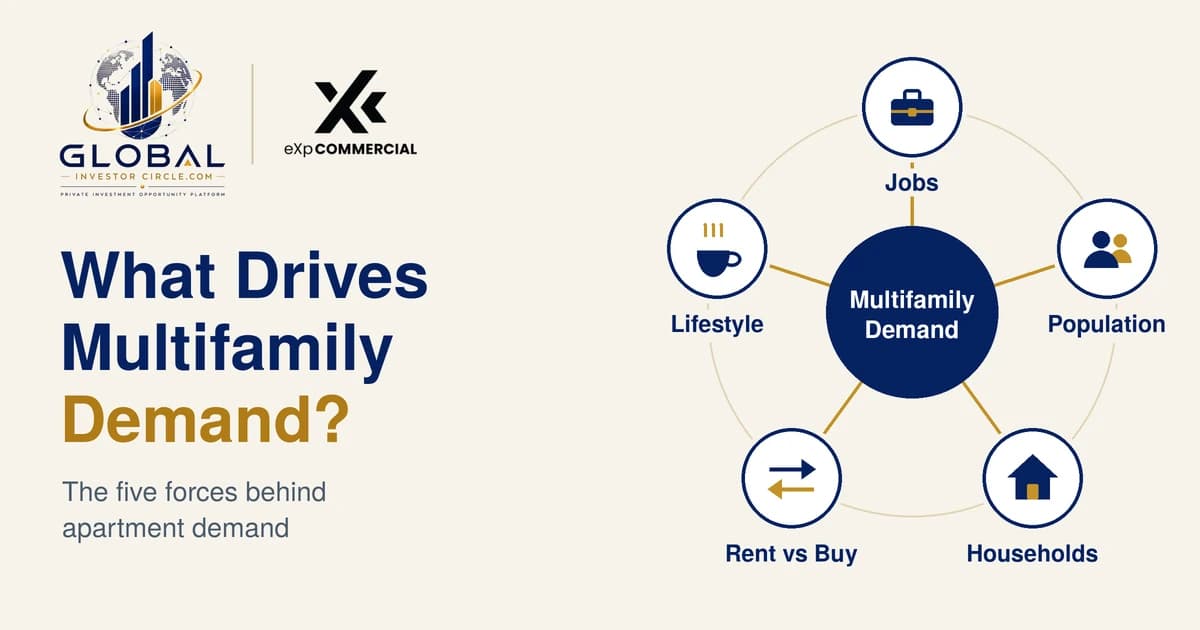
Understanding a multifamily investment starts with the local rental market. Five key factors shape U.S. multifamily demand: job growth, population and migration trends, household formation, the cost of renting versus buying, and lifestyle preferences. Together, these factors influence how many households seek apartments, where they choose to live, and what they can afford.
Demand, however, must be considered alongside supply. A growing city can attract renters while experiencing pressure on rents if new apartments become available faster than households occupy them.
This guide explains the five main multifamily demand drivers, how new construction affects rental markets, and seven market checks private investors can use when reviewing a multifamily opportunity.
The Five Core Drivers of Multifamily Demand
1. Job Growth and Employment Diversity
Employment growth can attract new residents and help existing residents afford housing. For apartment investors, both the number and type of jobs matter.
A market with employment spread across several industries is less dependent on the fortunes of one employer. By comparison, a major closure or reduction in hiring can have a greater impact on a market with a concentrated job base.
Look beyond announcements of new facilities or corporate relocations. Check whether jobs are being added, whether wages support local rents, and how accessible employment centers are from the property.
2. Population Growth and Net Migration
People moving into an area can increase housing demand. Net migration—the difference between people moving into and out of an area—helps investors understand whether relocation is contributing to growth.
However, additional residents do not automatically become apartment renters. Some buy homes, share housing, or move in with family.
Consider who is arriving, their likely housing budgets, and whether the property’s location and unit types meet their needs.
3. Household Formation
Housing demand depends on the number of households as well as the number of residents.
Adults moving out of their parents’ homes, roommates establishing separate homes, and changes in family circumstances can create additional housing demand. Some of that demand flows into rental apartments.
The reverse can also occur. If living costs lead more people to share homes, household formation may slow even when the population continues to grow.
4. The Cost of Renting Versus Buying
The relative cost of homeownership influences whether households rent or buy. Home prices, mortgage rates, down-payment requirements, property taxes, insurance, and maintenance all affect that comparison.
When ownership is substantially more expensive, some households may remain renters longer. When buying becomes more accessible, some may leave the rental market.
That does not mean landlords can raise rents indefinitely. Renters’ incomes and competing housing options still determine what they can afford.
5. Lifestyle and Life Stage
Some households choose to rent for flexibility, convenient locations, or fewer maintenance responsibilities. Others rent while relocating, saving for a home, or navigating a change in family circumstances.
These preferences affect demand for different properties. An apartment near employment centers may appeal to a different household than a larger suburban unit.
The practical question is whether the property’s location, layout, amenities, and rent match the people likely to live there.
How New Apartment Supply Affects Occupancy and Rents
Strong demand does not guarantee rising rents. If competing apartment communities open faster than renters occupy them, owners may face longer leasing periods or offer concessions such as free rent.
This makes the construction pipeline an important part of multifamily market analysis. Review projects that are proposed, permitted, under construction, and recently completed separately. Each represents a different stage of potential competition.
Fewer construction starts may reduce future deliveries, but the timing depends on projects already underway and how long construction takes. A slower pipeline can ease competition; it does not guarantee a recovery in rents.
For example, two neighborhoods may both gain renters. If one also receives several large apartment developments while the other receives little new supply, their occupancy and rent trends may differ substantially.
Why Local Markets Matter More Than National Averages
National apartment market trends provide context, but they cannot explain conditions around an individual property.
Even within the same metropolitan area, neighborhoods can differ in employment access, household incomes, construction activity, and rental preferences. A property also competes most directly with apartments that attract similar renters—not necessarily every apartment nearby.
Two possible investment approaches illustrate this distinction:
Growth-focused markets: Investors may prioritize areas with expanding employment and population, while assessing how long new supply could pressure rents.
Markets with limited new supply: Investors may prioritize locations where geography, development costs, or regulations restrict construction, while examining demand, operating expenses, and purchase prices.
Neither approach guarantees better performance. The property’s price, financing, condition, management, and business plan remain important.
A Seven-Point Multifamily Market Evaluation Checklist
These questions help investors assess local conditions and discuss the assumptions behind a potential investment with its sponsor—the team organizing and managing the deal.
1. Is Employment Growing Across a Diverse Job Base?
Review job growth, major employers, industry concentration, and wage trends. Are employment opportunities expanding across several sectors, or does the area depend heavily on one business?
The U.S. Bureau of Labor Statistics provides metropolitan employment and unemployment data.
2. Are Population and Household Trends Supporting Demand?
Look at population growth, migration, and household formation over several years. Is growth consistent, or does it reflect a temporary change?
Use U.S. Census Bureau population estimates and household data to examine these patterns. Consider whether the households entering the market are likely to rent the type of property being evaluated.
3. How Much Competing Apartment Supply Is Coming?
Identify comparable properties that are planned, under construction, or newly opened in the competitive submarket.
Look at expected completion dates, unit types, asking rents, and target renters. Local planning records and the Census Building Permits Survey can help identify development activity, although permits do not establish when—or whether—a project will be completed.
4. What Do Occupancy and Concessions Reveal?
Ask how occupancy has changed at comparable properties and whether owners are offering incentives to attract or retain tenants.
Distinguish established properties from new communities still filling their initial units. High occupancy achieved through substantial discounts tells a different story from high occupancy maintained without incentives.
5. What Is Happening to Effective Rents?
Review rent trends over the past two years, including effective rents after concessions.
For example, an apartment advertised at $2,000 per month with one month free on a 12-month lease has an average effective rent of approximately $1,833 per month before other adjustments.
Ask whether the sponsor’s comparisons use advertised rents, signed lease rents, or effective rents. Using consistent measures makes the comparison more useful.
6. How Does Renting Compare With the Total Cost of Owning?
Compare renting with owning a reasonably comparable home in the same area.
Include mortgage payments, property taxes, insurance, maintenance, and applicable HOA fees. Consider down-payment and closing-cost requirements separately.
This provides a more meaningful affordability comparison than rent versus mortgage payments alone.
7. Are the Sponsor’s Assumptions Supported by Evidence?
Ask what rent growth, occupancy, concessions, and leasing timelines the business plan assumes. How do those projections compare with current local conditions?
Then examine the downside case. What happens if rents stay flat, vacancies increase, or new competition takes longer to lease?
Clear answers help investors understand the plan’s sensitivity to changing conditions. They should be considered alongside supporting data and the sponsor’s experience.
These seven checks focus on the market. A complete investment review also examines financing, property condition, operating expenses, fees, sponsor history, and offering terms.
Apply for Membership to Global Investor Circle
Accredited investors who want to learn more about private real estate opportunities can register with Global Investor Circle.
Frequently Asked Questions About Multifamily Demand
What are the main drivers of multifamily demand?
The main drivers are job growth, population and migration trends, household formation, the cost of renting versus buying, and lifestyle preferences. Their importance varies by location and renter segment.
Can a growing city still experience falling apartment rents?
Yes. If apartment deliveries outpace the number of households renting those units, vacancy and concessions can increase even while the city gains residents.
How do mortgage rates affect apartment demand?
Higher mortgage rates can increase the cost of buying a home, encouraging some households to rent longer. However, employment, income, home prices, and rental affordability also influence that decision.
Why is submarket research important?
A submarket is a smaller area within a broader market. Its renters, competing properties, and construction pipeline may differ considerably from citywide averages. Research at this level helps investors evaluate conditions relevant to a particular property.
Connect With Global Investor Circle
Evaluating multifamily demand starts with understanding who rents in a market, what they can afford, and how much competing housing is available. Those insights help investors ask better questions about a potential opportunity.
To learn more about Global Investor Circle and discuss your real estate investment interests, contact our team.
This article is for general educational purposes only. It is not investment, legal, or tax advice, or an offer to buy or sell securities. Real estate investments involve risk, including the possible loss of capital.